
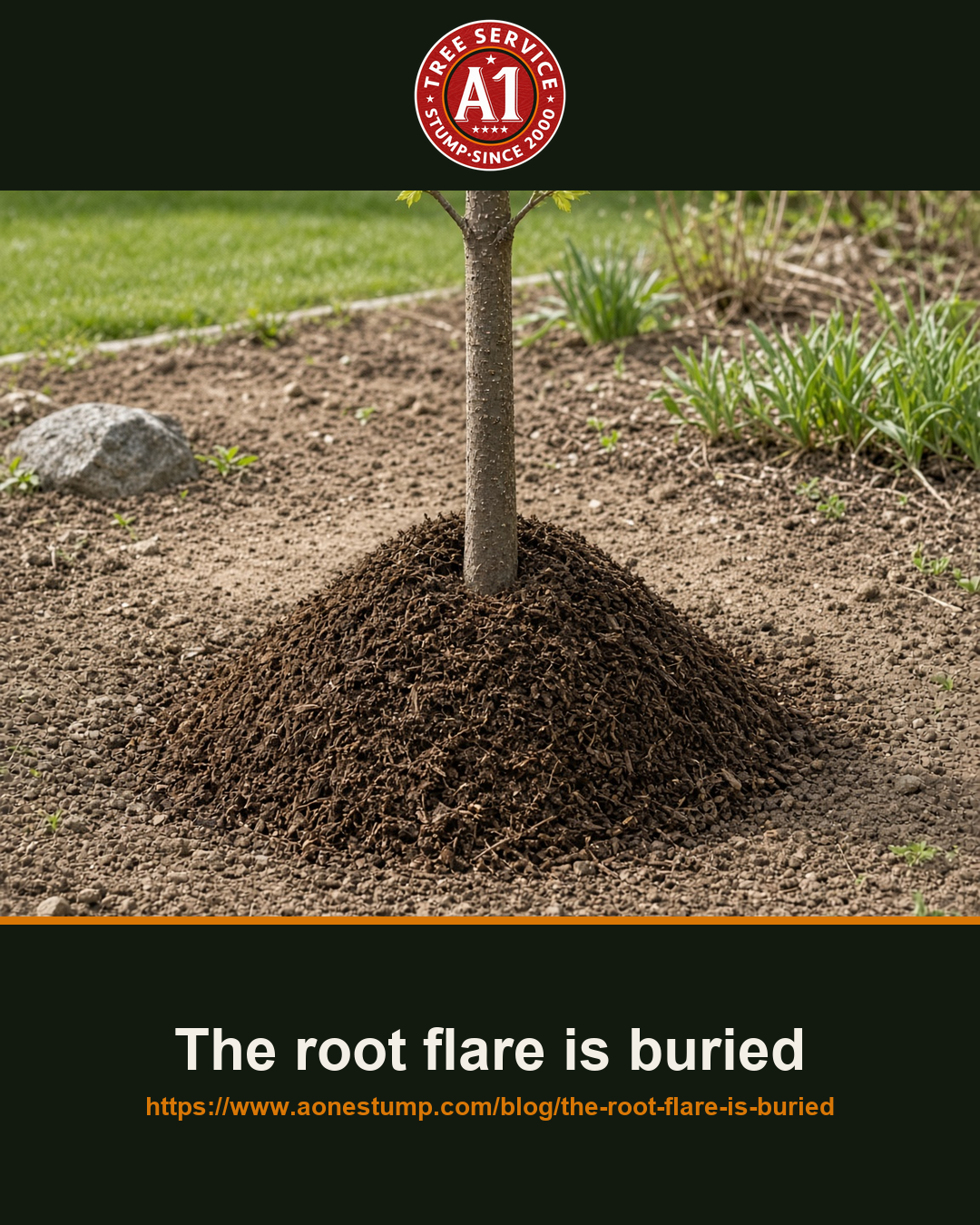
If you cannot see the flare, the tree is too deep.
The root flare is the widening at the base where the trunk becomes roots. It belongs at the soil surface, visible all the way around. A new tree that looks like a telephone pole stuck in the lawn was planted too deep, or someone built a mulch volcano against the bark. Either one keeps the trunk wet. The bark softens, roots circle, and the tree stalls or rots while the top still looks green.
Mulch is a ring. It is not a mound on the trunk.
What we see on a new planting
Nursery stock often arrives with the flare already buried in the potting soil. If that soil goes in the hole as-is, the tree is deep on day one. The hole should be wide, not a deep pit. Set the flare at grade, backfill with the soil you dug out, and water it in so it settles without sinking the trunk.
Mulch stays a couple of inches deep, pulled back so it does not touch the bark. A donut, not a cone. The same rule applies after stump grinding when you plant in a new spot nearby. Do not set the new tree down in the chip hole. Chips are not soil, and a buried flare in a rotting pocket is two problems at once.
A street-tree replacement has its own depth check, because the city is looking at the 15-gallon trees they counted when it was tagged for removal. Planting those too deep fails the inspection the same way a wrong species does.
A girdling root at the surface is a reason to look, not to mound more soil.
When it is already in the ground
If the tree has been deep for years and the canopy is still sound, do not excavate half the yard in July and call it a rescue. Photograph the base. If the flare is only an inch or two down and the bark is firm, pulling the mulch back and scraping the excess soil off the trunk is often the whole fix. If the trunk is soft, sunken, or sending out mushrooms at the soil line, send that photo before anyone replants on top of it. That may be a removal, not a regrade.
We flag when a permit may apply on a street tree or a heritage tree — you confirm with the city. We do not pull permits unless that is scoped in writing.
Start Easy Estimate with a photo of the base and the full tree, or call 408-439-6975.
Comments
No comments yet.