Live oak wood comes off in the dry season. Deadwood can come off any month.
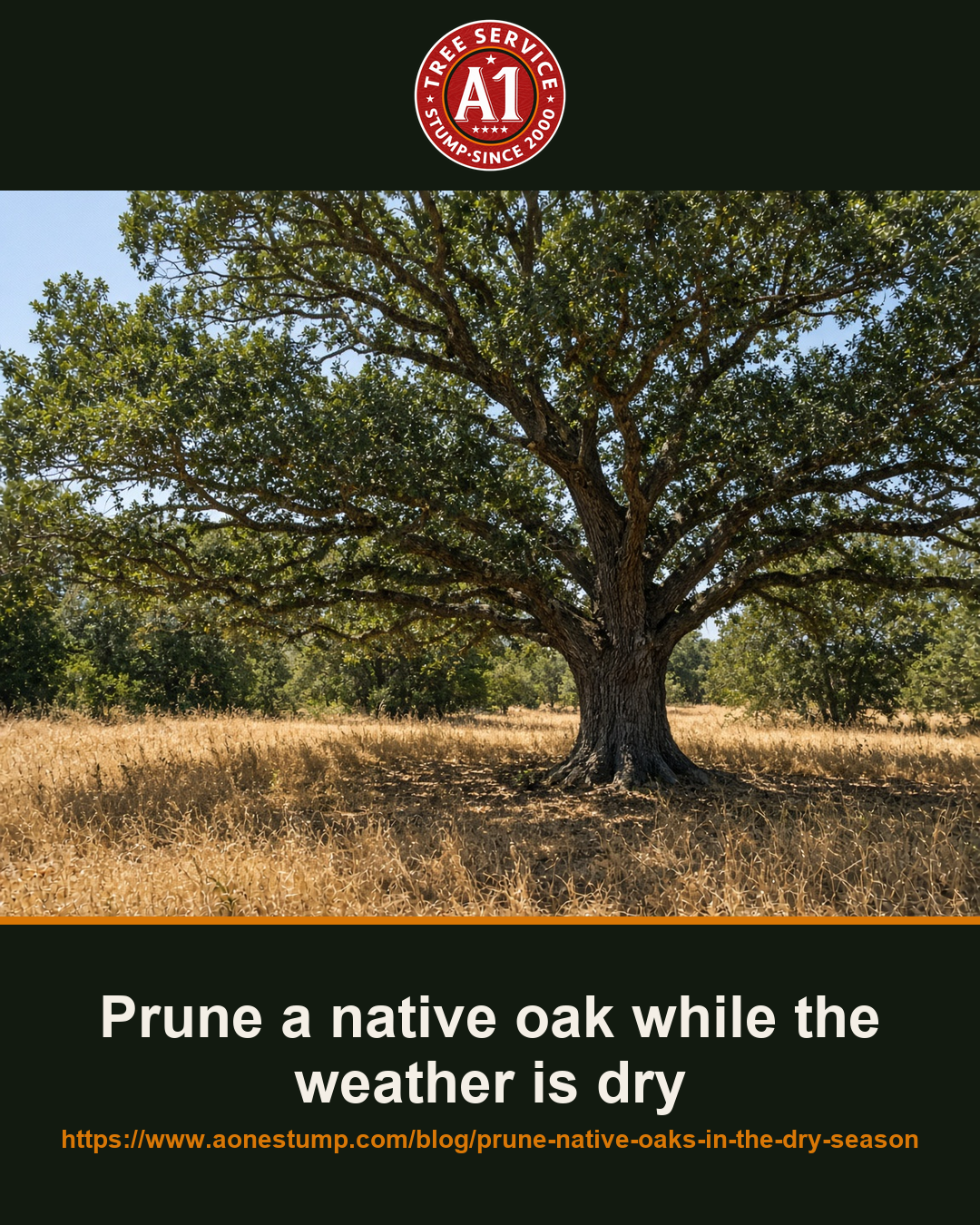
A coast live oak in a San Jose yard is not on the same calendar as a liquidambar or a fruit tree. Most trees want their heavy cuts in winter, while they are bare and quiet. Native oaks want the opposite for live wood: the dry stretch, about July through September, when the cuts are least likely to sit open in winter rain.
A wet-season haircut on live oak wood is the cut to skip.
What waits until it is dry
Leave the live canopy alone from about November through April, and through the spring flush. That is when decay fungi have rain to work with. A light clearance that can wait should wait. Topping, lion-tailing, and stripping the inside so only the tips have leaves are the wrong cut in any month. They do not make a smaller, safer oak. They make weak sprouts and a tree that fails later.
Deadwood is the exception. A dead limb over the roof, the drive, or the pasture comes out when you see it. Dead wood is not the wet-season problem. A cracked limb that is already moving is emergency or a scheduled trim, not a reason to reshape the whole tree because you have a crew in the yard.
Valley oaks and coast live oaks are both native here. They still do not share every disease. Do not treat a summer prune on a sound oak as a sudden-oak-death treatment. If the trunk is bleeding or the canopy is browning from the top, send those photos before anyone cuts live wood.
Clearance over the house is a few cuts. It is not a third of the tree.
How much comes off
Street-tree rules in San Jose cap a prune at about a quarter of the live canopy in a year, with clearance over the street and the walk. A private-yard oak does not automatically follow that sheet, but the same idea holds: take the limb that reaches the house, not the whole interior. We flag when a permit may apply — a street tree or a heritage tree often does. You confirm with the city. We do not pull permits unless that is scoped in writing.
Photograph the full canopy, the trunk, and the one limb that worries you. Note whether it is dead or still leafed out. That is enough to tell a dry-season prune from a removal.
Start Easy Estimate or call 408-439-6975.
Comments
No comments yet.